There are a lot of components inside of a warehouse to consider when your designing a new storage system. The following is a list of terms you may hear during the warehouse design process. Many of them pertain to rack structures, pallet racks, and loads, including how they are structured, how they operate, and their safety factors.
In order to gain a general understanding of the structural components, you will find inside of the facility, we recommend reading these definitions first.
Automatic Retrieval and Storage Systems
Rack structures that feature a stacker crane, or similar vehicle to load and unload racks without using an on-board operator.
Applicable Code
Code that is enforced by the local building department where the structure is designed.
Allowable Strength Design (ASD)
A process of keeping structural components organized, where the allowable strength equals or exceeds a component’s required strength under the ASD load combinations.
ASD Load Combination
Pertains to applicable building code load combinations that are intended for allowable stress design, or allowable strength design.
Beams
Structural horizontal members that resist bending movements.
Beam Locking Device
A mechanism such as a bolt or a pin that prevents the beam connector from becoming disconnected from the column.
Braced Frames
Truss systems that resist lateral forces and offer structural system stability.
Buckling
Under a critical loading condition, the limit of the sudden change of a geometric structure or its elements.
Buckling Strength
The strength for instability or buckling limit states.
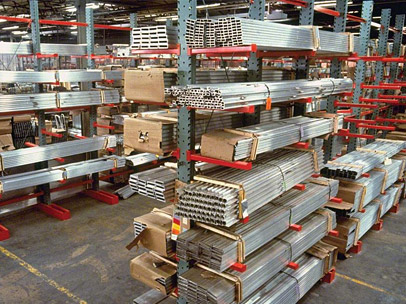 Cantilever Pallet Rack
Rack structures constructed primarily of horizontal arms, extended bases, and vertical columns extending from the down-aisle bracing between the columns and from the face of the columns. Depending on the products that are being stored, shelf beams can sometimes be found between arms. Cantilever columns are overhead tied or free-standing.
Cladding
A structure’s exterior covering.
Column
Structural members that resist axial force as a primary function.
Concurrent Forces
Multiple forces at a single location that act in conjunction with each other.
Connection
A combination of joints and structural elements that are used to transmit forces between multiple members.
Design Load
Applied loads that are determined according to ASD or LRFD load combinations, depending on applicability.
Design Strength
The resistance factor multiplied by the minimum strength [Φ Rn].
Design Stress
The strength of the design divided by the apposite section property, like a cross-section area or a section modulus.
Diagonal Bracing
In a braced frame, the inclined structural member that primarily carries axial force.
Distortional Buckling
Excluding local buckling, this type of buckling involves a change in the cross-sectional shape.
Double-Stacking
Shelves containing loads that are stacked one on top of each other in a pallet position.
 Drive-In Pallet Rack
Rack structures primarily comprised of horizontal load rails and support arms, and vertical upright frames used typically for storage that is one-wide by multiple-depth. These structures include anchor sections with horizontal beams that support the load rails. In a bay, loading and unloading can only be done from the same aisle. Two-way drive-in racks contain rows of drive-in racks back-to-back. With a common rear post, they are combined into a single entity.
Drive-Through Rack
Rack structures primarily comprised of horizontal support arms and load rails, and vertical upright frames. They are primarily used for storage that is one-wide by multiple-depth. The structures do not contain anchor sections like drive-in racks, meaning that loading and unloading can be done from either end of the bay.
Effective Length
When analyzed with pinned end conditions, this is the length of an identical column that has the same strength.
Effective Length Factor
Ratio between the effective and unbraced length of a member.
Effective Section Modulus
To account for slender compression elements becoming buckled, the section modulus is reduced.
Effective Width
Width of a slab or plate becomes reduced, with an expected uniform stress distribution that produces similar effects on a structural member’s behavior as an actual slab or plate with a non-uniform stress distribution.
Factored Load
Product of the load factor along with the nominal load.
Flexural Buckling
A buckling mode where the compression member laterally deflects without a change or twist in cross-sectional shape.
Flexural-Torsional Buckling
A buckling mode where the compression member simultaneously twists and bends without a change in cross-sectional shape.
Force
Results in stress distribution over a set area.
Gravity Load
Loads produced by live and dead loads that act in a downward direction.
Kick-Plate
A vertical angle or barrier (plate) that is installed near the edge of a raised floor. Prevents loose items from sliding off the floor’s edge.
Load Factor
Accounts for aberrations of a nominal load from an actual load for analytic uncertainties that transform loads into load effects, and for the likelihood that several extreme loads may occur instantaneously.
Local Buckling
Within a cross-section, this limits a compression element’s buckling state.
Movable Shelf Rack
Rack structures mainly composed of horizontal shelf beams and vertical upright frames that are primarily used for hand-stack or one-deep pallet storage. A couple of shelf level locations are fixed, while the location of in-fill shelves is flexible.
Net Area
The gross area is reduced in order to account for removed material.
Nominal Strength
The strength of a component or a structure without a safety or resistance factor applied to resist the effects of loads, which is determined according to this specification.
Out-of-Plumb Ratio
From the centerline of a column at the floor, this is the maximum horizontal distance, in inches, to a plumb line that extends down from the column’s centerline at the top shelf elevation divided by a vertical distance, in feet, from the floor to the elevated top shelf.
Pallet Beam
The back and front shelf members that transfer loads to the upright frames and bear the weight of each load.
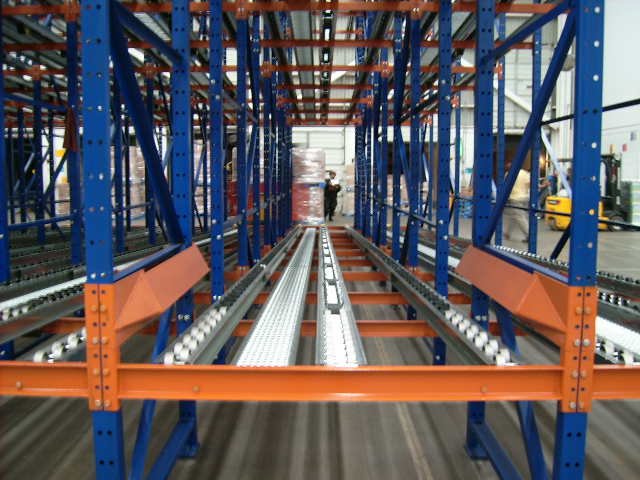 Pallet Flow Rack
Specialized pallet rack structures where the pallet-flow lanes are supported by the horizontal shelf beams. The lanes are mounted to a slight pitch that permits multiple-depth pallet storage with unloading from one service aisle and loading from another service aisle.
Pallet Load Support Member
Load-bearing members that contain a long axis on a horizontal plane. They are used to support unit loads that are in direct contact (shelf and pallet beams and supports).
Pallet Rack
Rack structures primarily comprised of horizontal shelf beams and vertical upright frames that are used for one or two-deep pallet storage.
Pallet Supports
Components that extend between the shelf beams and aid in the support of a stored load at any given level underneath.
Permissible Strength
The nominal strength divided by the safety factor.
Permissible Stress
The allowable strength divided by an appropriate section property such as a cross-section area or a section modulus.
Pick Modules
Rack structures primarily comprised of horizontal beams and vertical frames containing one or multiple platform levels of pallet flow, case-flow, or selective bays that feed into a central pick aisle work platform and are supported by the structure of the rack.
Plaque
Prominent, permanent signage that depicts permissible rack loads.
Stacking Frames/Portable Rack
Assemblies containing four corner columns that allow one assembly to be stacked on top of another without applying an additional load to the products that are stored on each assembly.
Product Load
The weight of each item that’s placed on a rack.
 Push-Back Pallet Rack
Specialized pallet rack structures containing horizontal shelf beams that support push-back lanes comprised of carts and tracks. Each push-back lane is installed on a slight pitch, which allows for multi-depth pallet storage. The pallets are pushed back during unloading and loading from the same service aisle.
Rack Supported Platforms
Decked working surfaces that are supported by rack structures.
Rack Supported Structure
Similar to other rack structures, these structures include roof purlins and wall girts or equivalent apparatuses to support roof and wall cladding. In addition to normal storage rack loads, these structures can also carry rain, snow, and wind loads.
Safety Factor
A factor that accounts for aberrations of actual strength from nominal strength, the actual load from the nominal load, analytic uncertainties that transform loads into load effects, and for the consequences and manner of failure. The allowable load for an allowable strength design is determined by dividing the nominal load by the safety factor.
Safety Flooring
Surfaces found in areas where order pickers step off a pick module walkway or a normal walking area, to dislodge loads that were not flowed properly, so they can be moved to the correct position.
Selective Pallet Rack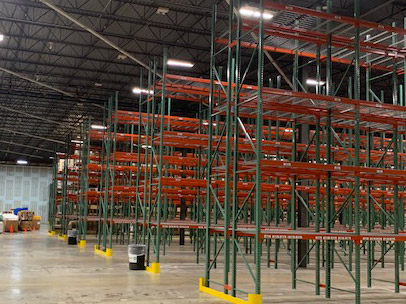
The most popular and versatile style of pallet racking systems due to its direct access to every load providing efficient use of floor space and minimal load/unload times.
Sidesway Buckling
The limit state of lateral buckling of a tension flange contrary to the position of a concentrated compression force.
Site Class Definition
Classifications assigned to specific locations based on the types of soils that are present.
Stress
Force per unit area as a direct result of torsion, shear, moment, or axial force.
Structural System
Load-carrying components that provide interdependence or interaction when they are joined together.
Stub Column Test
Members that are unaffected by column buckling are tested using concentric compression in order to determine the effectiveness of a column.
Torsional Buckling
A buckling method where compression members twist about their shear center axis.
Torsional-Flexural Buckling
A buckling method where compression members twist and bend instantaneously without any changes in cross-section shape.
Trussed-Braced Upright Frame
Upright frames containing two columns that are similar to truss chords with horizontal and diagonal bracing located between and attached to the columns. The horizontals and diagonals are the truss’s web members, also known as a vertical truss.
Unbraced Length
The distance between a member’s braced points measured between the bracing members’ centers of gravity.
Unit Load
The total expected weight to be positioned in a rack, consisting of the pallet weight and product load.
Upright Frame
A structural assemblage that carries the horizontal and vertical loads to the floor, made up of two columns and bracing members located between the columns. The rack beams are attached to the frame’s columns. The loads are then carried to the columns.
Vertical Impact Load
Added downward force to the beams, which occurs while a rack is being loaded.
Yield Strength
Stress that occurs when a material experiences a specific limited aberration from the proportionality of stress to strain according to ASTM.