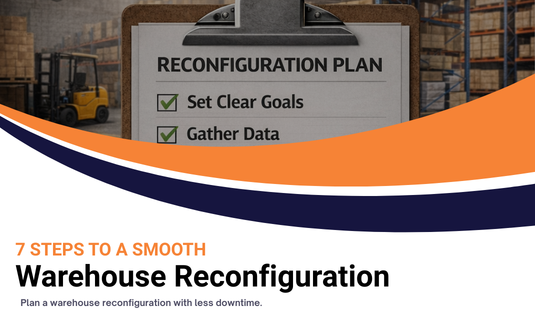
Do you want to supercharge the productivity of your warehouse operation? Do you want to streamline your business, increase output, and reduce accidents? If so, these organizational tips will help you do just that. First, you will need to optimize your warehouse organization. The flow and layout of your operations will determine how well your warehouse operates from receiving to storing to shipping.
You can improve the efficiency and speed of your staff and organize your warehouse with these six organizational tips.
Warehouse Organization Tips
 Reevaluate Your Warehouse Design Layout
Your warehouse design layout is the foundation of a successful warehouse. You can’t optimize your facility without it. Here are a few principles you should keep in mind when updating or planning your warehouse design:
- Flow
The continuous movement of traffic, people, and materials within your facility - Accessibility
Each product, including products on pallets, should be easily accessible without needing to move one product in order to get to another - Space
The maximum amount of space you can afford, taking battery charging, empty pallet storage, working areas, offices, stock, and storage into consideration
Learn more about our Warehouse Design Service

 Using Racking Organization
Keeping your racks organized keeps your inventory stored vertically on pallet racks instead of horizontally. It’s a cost-effective solution to maximize your space if your warehouse carries lots of inventory, or if you have a smaller facility and cannot afford to expand upon your existing space.
Vertical racks will give you additional space on the ground for trucks and forklifts to move around your warehouse easily, as well as extra space to safely stock inventory and more employee work areas.
Learn more about the different types of pallet rack systems
 Using ABC Analysis to Set Inventory Up
ABC inventory analysis sorts inventory into 3 different categories based on how much they cost to hold and how well they sell:
- A Items: Top-selling items that take up little space or cost
- B Items: Mid-range items that regularly sell but cost more to hold than A-items
- C Items: The remainder of your inventory that makes up most of your inventory costs and contributes the least to your overall bottom line
ABC inventory analysis is one example of how Pareto’s 80/20 principle can be applied. Most of your profits are generated from only 20% of your overall inventory. Once your inventory has been grouped into ABC categories, your pick and pack area should be arranged in a way that offers your employees easier access to A SKUs, B SKUs, and C SKUs.
 Keeping Your Facility Clean
Sounds pretty simple, right? The likelihood of safety accidents and hazards increases if you have excess clutter in your warehouse, as well as reduced productivity among your staff. A dirty, disorganized warehouse could also raise the cost of your inventory if you have anything stored that is obsolete.
A well-organized warehouse, on the other hand, will increase your throughput and efficiency and improve your lead times.
 Keeping Warehouse Inventory Labeled
Your employees should not have to memorize all of the items that you have in your warehouse. For easy identification, each SKU should be labeled clearly. Your labeling should be consistent (e.g., labeling the bottom right corner of every box) for each item and include the following information on each label:
- Date
- Size
- Color
- SKU
- Other pertinent information
 Make Receiving Inventory Easy
Optimizing inventory receiving is a key warehouse management tip, as it sets the tone for your inventory and warehouse processes. If your inventory isn’t received efficiently, the rest of your operations will fail.
You can improve inventory receiving by doing the following:
- Provide enough space along with the proper tools to allow your staff to store and sort incoming inventory by optimizing your receiving space.
- Put tools away after using them and remove clutter to keep your receiving space clean.
- Implement an inventory system to reduce incorrect shipments, missing inventory and miscounts. This will help you track inventory in real-time.
- Hire a quality control manager to keep an eye out for mistakes, point out procedures that may be problematic, and decrease instances of inventory damage.
- Use the appropriate machines (e.g., conveyor belts and forklifts) to unload inventory safely and quickly.
- Verify the goods that are received by using metrics such as the batch tracking number, product code, or description of goods to avoid shipping the wrong products to your customers.
You should review your warehouse operations to continue to improve the organization of your facility. Verify that you’re improving your employees’ productivity and maximizing your warehouse space regularly, from equipment placement to flow of processes to policy effectiveness.
When you identify problems in your processes sooner than later, it will positively affect your company’s bottom line. Contact us today to assist you with Everything Warehouse!