
Selective pallet rack is a popular method of storage for warehouses and other facilities that store inventory. While the beams in your system work hard to support your pallets, it’s usually best to have pallet supports in place as well. But should you choose crossbar or wire decking supports?
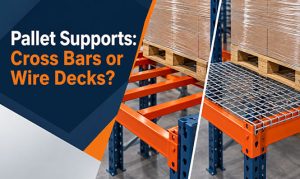
Both options are a good safety measure to prevent items or whole pallets from falling between the beams, causing a loss of inventory and money. They help with extra support for the pallet. Crossbars are the simplest choice if you don’t have any loose items to store. They typically consist of two bars per pallet position, and they sit on or in the pallet rack beams to hold the pallet. Crossbars are also used to stop the beams from spreading over time. While crossbar supports are better than no support at all, they can still allow smaller pieces to fall through.
Wire Decks
 Wire decking provides more complete support than crossbars, with a single wire deck typically covering an entire pallet position rather than just two support points. Made from welded wire mesh, wire decks are preferred over particle board or solid steel shelf panels for two main reasons: their open design allows visibility through every level of the rack, and they meet fire code requirements for high-piled storage – a compliance factor crossbars don’t address on their own.
Wire decks are also more versatile than crossbars. Because they provide full-surface support, they work for both palletized and non-palletized items, and they’re commonly used not just with selective pallet rack but with rivet shelving as well. That flexibility comes at a higher cost than crossbars, but for most warehouses, the added support, visibility, and code compliance make wire decking the more commonly used option of the two.
Wire decks are a good fit when:
- You’re storing loose items, damaged pallets, or mixed inventory
- Your facility requires fire code compliance for high-piled storage
- You want full sightline visibility through the rack for inventory checks
- You need one system that works across both pallet rack and shelving
Add comparison table
 Crossbars
 are the simplest pallet support option, typically consisting of two bars per pallet position that sit on or in the pallet rack beams to hold the pallet in place. Beyond supporting the load itself, crossbars also help prevent the beams from spreading apart over time, adding a measure of structural stability to the rack.
Crossbars work best when you’re storing standard, intact pallets without loose items – cartons, shrink-wrapped goods, or uniform packaged products that won’t shift or break apart on the rack. Because they only span the width of the pallet at two points rather than covering the full surface, crossbars leave gaps that smaller items, broken cartons, or loose product can fall through. If your inventory is consistently palletized and uniform, that’s rarely a problem. If it’s mixed, damaged, or loosely packed, it’s worth considering wire decking instead.
Crossbars are a good fit when:
- You’re storing standard, undamaged pallets with no loose items
- Budget is a primary consideration
- Your inventory doesn’t require fire code compliance for high-piled storage
Comparison Table
| Crossbars | Wire Decks | |
|---|---|---|
| Coverage | 2 bars per pallet position | 1 deck per pallet position (full coverage) |
| Best for | Palletized loads only, no loose items | Palletized and non-palletized items |
| Fire code (high-piled storage) | Not addressed | Meets fire code requirements |
| Cost | Lower | Higher |
| Compatibility | Selective pallet rack | Selective pallet rack, rivet shelving |
To further secure your inventory on selective pallet rack, pallet supports should be utilized. Whether you choose crossbars or wire decking is up to you. If you need help deciding, give us a call and we would be glad to give you more information and evaluate your individual needs.


