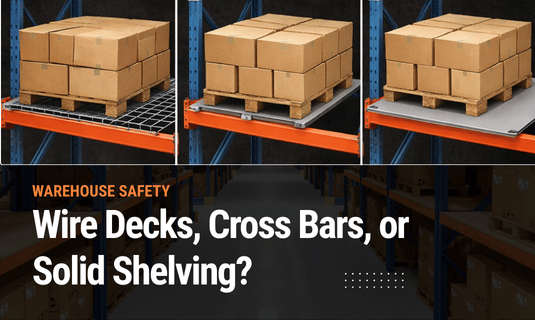
Warehouse safety can be a tough issue to deal with. Warehouses are always fluctuating, making it an ongoing challenge. Where does one start?
Rack safety and general workplace safety are two different – but connected – disciplines. The 5 steps below focus on keeping your pallet rack system structurally sound. After that, we’ve rounded up the everyday practices – PPE, hazard labeling, safe lifting, forklift conduct, and workplace culture – that keep the rest of your warehouse safe.
As long as you’re able to complete the tasks below, your warehouse will be a lot safer, and your racks will stay in good shape.
1. Regular Inspections

Your warehouse should be inspected regularly, and this should be the first step in determining the condition of your racks. Trained employees or a third party can conduct these inspections. They are done by a person who carefully observes the racks as they walk through the facility. Don’t rely on forklift impact sensors or sensors located directly on the rack to look for damage due to rubbing pallets on braces and columns. These sensors won’t forewarn you of dislocated safety pins or safety bars either. There are no other solutions that can help you determine if your racks are compliant. Inspections not only help you find damage – you may have lost count of who did what or when the racks may have been modified since they were installed.
Pallet Rack Inspection Frequency
Frequent inspections depend on the level of safety culture and the activity that takes place in your warehouse. You should regularly inspect your racks and report any damage immediately.
If there is a lot of heavy forklift traffic or activity, you may want to perform these inspections daily or weekly. You can even conduct these inspections in specific zones or aisles that are considered high-risk, like a shipping and loading area.
Quarterly or monthly inspections should be scheduled and conducted by trained staff.
Annual inspections may need to be conducted by an expert to measure your facility’s progress from year to year or to get a baseline survey.
2. Address the Problems

After you have located the damage, the trouble spots should be prioritized and tended to right away. You need to have a plan. Your warehouse inspectors will be tasked with determining and prioritizing the issues that need to be addressed first. The design codes don’t always make this clear. If a third party has been mandated to inspect your racks, ask them to give you a list of priorities. The priority levels we use are simple: Low Priority, Medium Priority, High Priority, and Unload. Every warehouse manager we’ve worked with has told us they have limited time and limited budgets to work with, which is why we always focus on fixing the most critical issues first and foremost.
Uprights can be replaced or repaired. If you are using OEM parts, make sure the components are replaced like for like. Make sure your supplier uses an engineered repair solution that restores the rack’s load capacity and maintains its original configuration.
3. Protect Your Assets and Employees

We need to be proactive about protecting our most valuable resources: assets, products, and people. You should consider installing end-of-row protection and column guards in heavy traffic areas. The lower part of the uprights should be protected where they are most likely to get hit. Guardrails should be placed in pedestrian walkways. Accessories such as safety bars, netting, panels, wire mesh decking, etc., should also be used to protect against falling objects.
When storing inventory, keep heavier items on the middle or lower levels of the rack rather than up high – a top-heavy load is far more likely to become unstable if the system is bumped or shifted. Keep aisles clear so forklifts can maneuver safely for picking, and when removing inventory, take one item at a time rather than pulling multiple pallets in a way that could destabilize what’s left on the rack.
4. Conduct Rack Safety Training

Once the most critical issues are scheduled to be addressed or have already been taken care of, you need to train your workforce on rack safety so they can ensure their own safety and that of others by spotting any damage they find. They must understand the dangers of accumulated damage. Make sure the training covers every aspect of the inspection your workers will need to know. It should bring awareness to fire safety codes, rack design codes, building codes, and other important regulations.
Effective training reduces forklift accidents by 25% to 30% according to OSHA, which is significant when you think of the following benefits:
- Avoiding OSHA fines
- Extending the life of your racks
- Less damage to equipment, products, and property
- Lowered insurance premiums/reduced liability
- Reduced maintenance costs and injuries
Training shouldn’t be a one-time event. Hold regular refresher courses so staff stay current on safe practices, and make sure every forklift operator is properly licensed and authorized before they operate equipment – never allow anyone to drive a forklift or use powered equipment without training or authorization.
5. Document and Report

Warehouse safety is an ongoing process, which is why you will want to keep documentation of what is happening to your racks so that accountability can be brought to the process if needed. When you report and track issues, the chain of command understands what needs to be done so that everyone at every level is informed. This pushes accountability for the examined issues. Reporting and tracking also provide you with a timeline you can review during every inspection.
Everyday Warehouse Safety Practices
Rack inspections and repairs protect your storage system – but day-to-day safety depends just as much on the habits of everyone working around that system. Here’s what to have in place beyond the rack itself.
Personal Protective Equipment and Basic Precautions
Forklifts or hydraulic dollies should always be used to lift items that are too heavy to move by hand. Appropriate eyewear and hard hats should be worn when required. Make sure employees know the location of emergency exits, and never block sprinklers installed in the roof. Safety equipment can feel like it slows things down in the moment, but it consistently pays off by reducing workplace injuries.
Lighting matters too – proper lighting throughout the facility helps workers maintain good visibility and keep up with changing surroundings as they move through the warehouse.
Eliminate Slip, Trip, and Fall Hazards
Warehouse floors should be kept free of stray cords, liquids, and other tripping hazards at all times – this should be a regular check carried out by all employees, not just a scheduled inspection. Cracks and pits in the flooring should be repaired promptly, since they can cause serious injury as well as damage to expensive equipment. A well-organized, clean warehouse is consistently a safer one.
Clearly Label Hazardous Zones
Dangerous equipment should be stored in a clearly labeled, secure area, and safe walkways should be highlighted with signage. Floor tape or painted stripes are an easy, effective way to mark off high-risk zones so employees know at a glance where to be cautious. Equipment should also have nearby signage noting relevant safety expectations and possible dangers, so the information stays visible while people are working.
Safe Lifting and Material Handling
Before moving a load, assess the best method for transporting it. If lifting is the right approach, check the route for obstacles first and confirm there’s enough space at the destination. Lift with your legs, not your back, to minimize strain and injury, and never let a load block your view while carrying it. Where possible, push rather than pull material handling equipment, and lean in the direction you’re traveling. If something is too heavy, don’t hesitate to ask a coworker for help.
Forklift and Equipment Operator Safety
Forklifts can only be operated by a trained, licensed employee – never allow untrained or unauthorized staff to operate one. Stay alert at all times and never get too comfortable around powered equipment; a large share of forklift incidents happen when an operator or pedestrian isn’t paying attention to their surroundings. Operators and pedestrians alike should communicate their location as they move – a simple call-out when rounding a corner or crossing an aisle can prevent a collision before it happens.
Loading Dock Safety
Loading docks present a fall risk if they aren’t clearly marked. Use safety tape and signage to keep employees alert near the edge, and make sure dock equipment is properly secured and rated for a high enough weight capacity to safely handle what you’re loading and unloading.
Build a Culture of Safety
Safety training only works if it’s reinforced by how the warehouse actually operates day to day. Make safety a stated priority from an employee’s first day, and make sure supervisors are consistently seen following the same guidelines they expect from everyone else – that visible consistency does more to shape behavior than any single training session.
Encourage employees to report hazards the moment they see them, whether that’s a loose cord, a fallen box, or damaged equipment. A warehouse where staff feel responsible for flagging problems – not just for their own workstations – is a warehouse that catches small issues before they become serious ones.
Remember, safety should always be a top priority in the workplace. If you need help assessing your rack system or building out a broader safety plan, our team can help.