A lot of thought goes into permitting your warehouse. When it comes to the fire code side of a high piled storage permit, it depends on the size of the building, the fire protection system, and the material class being stored. In this post I will go over the basic fire code, and explain the different material classes and items that will change how you permit.
Currently in the United States, we use the International Fire Code. A permit is required when a building has an area of high piled storage greater than 500 square feet. High piled combustible storage is defined as storage where the top is greater than 12 feet, and/or the combustible materials are in closely packaged piles.
Getting your fire code permit again depends on the size of the building, the fire protection system, and the material class. There are different types of sprinklers that could be required as well as other systems that protect against or fight fire. I’ve included this chart to illustrate the safety requirements depending on what is being stored, and listed the definitions for the material and plastic classes below.

Commodities Classifications:
- Class I: Essentially noncombustible products on wooden or nonexpanded polyethelene solid deck pallets, such as: cement, appliances, ceramics, foods, glass
- Class II: Class I products in slatted wooden crates, solid wooden boxes or equivelent combustible packaging material with or without pallets, such as: food in combustible containers, incandescent or florescent lightbulbs in cartons, thinly coated fine wire on reels or in cartons
- Class III: Commodities of wood, paper, natural fiber cloth, or Group C plastics, such as: fertilizers, food in plastic containers, aerosol, furniture, lumber
- Class IV: Class I, II, or III products containing Group A plastics in ordinary corrugated cartons, or Class I, II, or III products with Group A plastic packaging, such as: aerosol, clothing, combustible metal, paints, pharmecueticals
- High Hazard: Products presenting a special fire hazard, such as: flammable solids, lacquers, vegetable oil or butter in plastic containers, rubber tires
Plastic Classifications:
- Group A: plastic materials having a heat of combustion that is much higher than that of ordinary combustibles, and a burning rate higher than that of Group B plastics
- Group B: plastic materials having a heat of combustion and burning heat higher than that of ordinary combustibles, but not as high as those of Group A plastics
- Group C: plastic materials having a heat of combustion and burning heat similar to those of ordinary combustibles
So, what you’re storing and how will decide which safety features will be required in your warehouse.
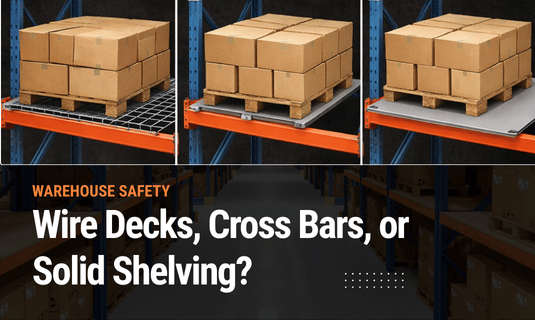
Pallet rack is generally treated in the fire code as rack with solid shelving. Wire decks are widely used so that your rack can be treated as rack without solid shelves, since the sprinkler system can still reach all of the levels through the mesh. You don’t have to have in-rack sprinklers or as much fire safety equipment if there are no solid shelves.
Since there are so many different pieces that play a part in permitting your storage system, often it is easier to have a company take care of it for you. Contact us for more information on the permitting process.