
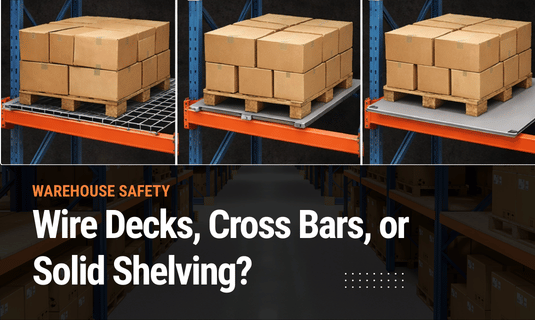
When warehouse incidents happen, the failure typically occurs at the beam level. That is where Wire Decks, Cross Bars, Solid Shelving, and overall Pallet Support Systems carry thousands of pounds daily. The wrong pallet support system can increase deflection, allow pallet failure, restrict sprinkler performance, or create hidden structural stress.
Warehouse leaders must look beyond simple rack capacity numbers. The safest operation comes from aligning pallet condition, load weight, fire protection, and material flow with the right Pallet Support solution
This blogs compares Wire Decks, Cross Bars, and Solid Shelving to help you determine which option delivers the safest outcome for your operation.
Why Pallet Support Is a Warehouse Safety Decision
Most selective pallet rack systems are engineered for vertical strength. However, Pallet Support determines how the weight is distributed horizontally across beams.
Improper support creates:
- Concentrated beam stress
- Pallet board failure
- Product drop risk
- Increased liability exposure
Warehouse safety audits consistently show that pallet failure contributes to rack damage incidents. Often the issue is not overload, but uneven load distribution caused by poor rack beam support.
A critical insight often overlooked is pallet quality variability. In high-volume distribution centers, pallets come from multiple suppliers. Some are new. Others are cracked or warped. A strong Pallet Support system compensates for that inconsistency.
When evaluating warehouse rack safety, beam strength alone is not enough. Support systems determine long-term stability.
Wire Decks and Their Warehouse Safety Advantages
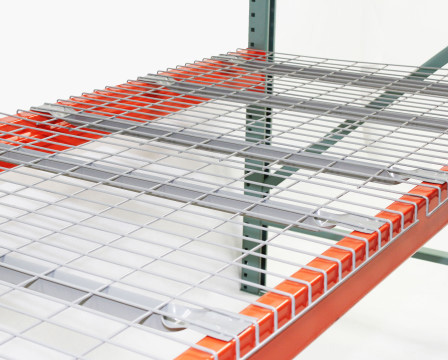
Wire Decks remain the most widely used Pallet Support solution in modern warehouses. They consist of welded steel grids reinforced with channel supports.
Key Benefits
Wire decking for pallet racks provides even load distribution and strong pallet failure protection. If a pallet board cracks, the wire grid catches product before it falls through.
Another major benefit is fire code compatibility. Open wire allows sprinkler water to flow downward more effectively. Many fire inspectors favor this design in facilities without in-rack sprinklers.
Operational Strength
Wire Decks improve inspection visibility. Managers can easily see debris buildup or beam deflection. That transparency supports warehouse storage safety programs.
From a risk standpoint, Wire Decks balance cost, protection, and compliance. They support mixed pallet conditions better than Cross Bars alone.
Considerations
Wire Decks must match pallet rack load capacity ratings. Overloading can cause sagging. Always verify channel support spacing and beam capacity.
For most high-turn distribution centers, Wire Decks provide the safest blend of structural support and operational flexibility.
Cross Bars as a Reinforcement Option
Cross Bars offer a simpler Pallet Support method. These steel bars sit between beams to reduce deflection and reinforce pallet weight distribution.
Where Cross Bars Work Well
Cross Bars perform effectively when pallet quality is consistent and loads are uniform. In controlled manufacturing environments with standardized pallets, they can improve rack stability solutions. They are also budget-friendly compared to full decking systems.
Safety Limitations
Unlike Wire Decks, Cross Bars do not create a continuous support surface. If a pallet board breaks between bars, product can still fall through.
Cross Bars enhance beam reinforcement but do not provide full broken pallet protection. Although Cross Bars may appear adequate during visual inspection, they offer limited safety redundancy. In mixed pallet operations, this limitation increases risk exposure.
For facilities prioritizing warehouse safety, Cross Bars alone are often insufficient.
Solid Shelving and Maximum Coverage
Solid Shelving provides complete beam coverage using steel panels or engineered surfaces. It delivers the most continuous Pallet Support of the three options.
When Solid Shelving Is Ideal
Solid Shelving works well when storing:
- Drums
- Cartons without pallets
- Irregular loads
- Damaged pallet inventory
It prevents small items from falling and distributes weight across the entire rack level.
Fire and Engineering Considerations
Because Solid Shelving reduces airflow, fire code compliance requires review. Sprinkler systems may need adjustment depending on rack configuration. Solid Shelving also increases weight per level. That must align with pallet rack load capacity and floor rating. While it offers maximum surface protection, it requires a more rigorous engineering review than Wire Decks or Cross Bars.
Safety Comparison Table
| Feature | Wire Decks | Cross Bars | Solid Shelving |
|---|---|---|---|
| Load Distribution | Even | Reinforced beam points | Full surface |
| Pallet Failure Protection | Strong | Limited | Maximum |
| Fire Compatibility | High | Moderate | Requires review |
| Cost Level | Moderate | Lower | Higher |
| Inspection Visibility | Excellent | Moderate | Limited |
Cost Versus Long-Term Risk
Upfront price often drives decisions between Wire Decks, Cross Bars, and Solid Shelving. However, the real comparison lies in long-term operational risk.
Consider these factors:
- Insurance exposure
- Worker injury potential
- Product damage costs
- Rack repair frequency
A lower initial investment in Cross Bars may increase risk if pallet conditions vary. Solid Shelving may raise fire engineering costs. Wire Decks often provide the most balanced Pallet Support return on investment across distribution environments. The safest system is the one aligned with actual warehouse behavior, not theoretical pallet perfection.
How to Choose the Safest Pallet Support
To select the right Pallet Support system, evaluate:
- Pallet quality consistency
- Product weight and dimensions
- Fire protection design
- Turnover rate
- Future expansion plans
High-volume distribution centers handling mixed pallets typically benefit most from Wire Decks.
Facilities with controlled pallet standards may utilize Cross Bars successfully.
Operations storing irregular loads may require Solid Shelving.
The safest solution matches storage reality with structural design.
Choosing between Wire Decks, Cross Bars, and Solid Shelving is not simply a purchasing decision. It is a structural safety strategy. Warehouse managers must evaluate pallet condition, load weight, fire systems, and growth plans before selecting a Pallet Support system.
Wire Decks often deliver the best blend of warehouse safety, compliance, and flexibility. Cross Bars may suit controlled environments. Solid Shelving offers maximum surface stability for specialized loads.
The safest warehouse is not the one with the strongest beams alone. It is the one with the right support beneath every pallet.
If you are reviewing rack upgrades or planning expansion, consult a warehouse specialist to assess your current support configuration and ensure it aligns with operational risk.
Are Wire Decks safer than Cross Bars?
For mixed pallet conditions, Wire Decks typically provide stronger pallet failure protection and better load distribution
When should Solid Shelving be used?
Solid Shelving works best for irregular loads or carton storage where full surface Pallet Support is required.
Do Cross Bars increase pallet rack load capacity?
They reduce beam deflection but do not create continuous support like Wire Decks.
Does Pallet Support affect fire code compliance?
Yes. Open wire systems are generally more sprinkler compatible than solid surfaces.
How often should Pallet Support systems be inspected?
At least annually, and after any rack impact or pallet quality change.


