
Warehouse Relocation Services
Stein Service & Supply specializes in warehouse and facility relocations. Whether the move is local or interstate, in one phase or several, we plan it so that operations continue in the old building until the new one is ready.
 Certified byRoss UllmanPresident, Stein Service & Supply

Relocation Services
We relocate pallet rack, shelving, mezzanines, modular offices, dock equipment, and conveyor from one building to another. Relocated rack is permitted and inspected the same as new rack. We manage each relocation from the first walkthrough through permit closeout.
We work mainly in North Carolina, South Carolina, Georgia, and Virginia, and in 2025 we completed projects in 24 other states.
- Walkthrough of both buildings and a new layout from our warehouse design team
- Teardown and tagging, with a damage check on every rack section and replacement footplates, beams, and frames from our stock
- Transport between buildings, local or interstate
- Reinstallation to the manufacturer’s load ratings, directed by an on-site project manager
- Permitting for the new building, from drawings through inspections and closeout
Reviewing the New Building Before the Lease
The first question about a new building is how high product can be stored in it. The maximum storage height in the new building depends on its sprinkler system. That system may differ from the one in the building being vacated, and it must be rated for the stored products at the planned height. Rack that stood at 20 feet in one building can be limited to 12 feet in the next.
A sprinkler upgrade can cost several hundred thousand dollars, and after the lease is signed, landlords rarely pay for it. We review every building under consideration against the stored products and report the maximum storage height for each.
When the sprinkler system is not sufficient for the stored products, storage height is limited. A tenant can sign a lease on a building with 30-foot ceilings and then find that storage is limited to 12 feet, with no other place for the inventory.
Changes When Rack Moves to a New Building
Before reinstallation, we check the rack from the old building against the new building, because any of the differences below can change the drawings.
| Item | What We Check |
|---|---|
| Storage height | When the sprinklers of the new building allow less height than in the old building, the rack is reinstalled with fewer beam levels or on shorter frames. |
| Beam levels | New beam elevations can change the capacity of an upright, and a larger gap between beams decreases it. The installer or a structural engineer must approve the new elevations. |
| Anchors | Anchors stay in the old floor. We install new anchors in the new building to the permit drawings. Some jurisdictions, mostly in South Carolina, require a third-party inspector, hired by the owner, to observe the anchor installation. |
| Seismic area | Rack moved into a seismic area such as Charleston can require larger base plates and more anchors, designed by an engineer. A used pick module we relocated for a pet food distributor required engineered changes and additional parts for this reason. Read the case study |
| Lighting and exits | Rack blocks light. Fixtures may need to move, and battery backup lights and exit signs may need to be added. A licensed electrician completes this work. |
| Fire alarm pull stations | Uprights must not block pull stations. When a packaging company moved into a new building, we identified pull stations that the new rack would have blocked and reported that they must be moved before installation. |
Phasing the Relocation Around Inspections
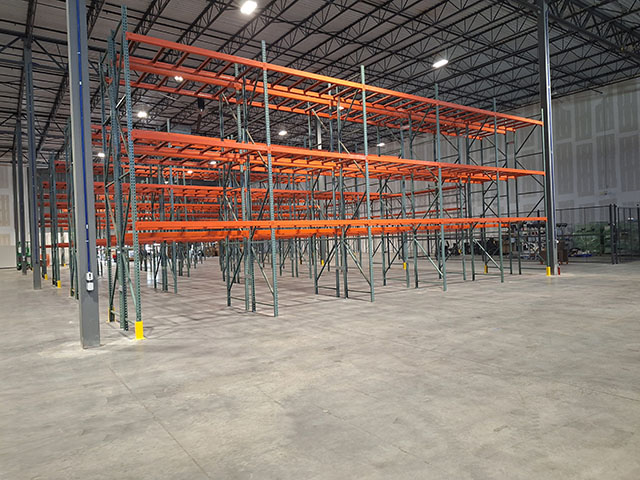
The inspections in the new building set the order of the reinstallation. Rack cannot hold product until it passes inspection, and uninspected rack occupies floor area, so we reinstall approximately one third of the rack and call for inspection. Once that section passes, the customer loads it and we reinstall the next third. Some jurisdictions question phased inspections, but most accept them once the reason is explained. Until inspection, product can usually be stored on the floor under the new rack, as long as the inspector can see the anchors.
A hospital system in Raleigh relocated in two phases. New rack and locking wire cages went into half of the new warehouse first, so the hospital could begin using it, and we then disassembled, moved, and reinstalled the existing rack in the other half. We obtained the high-piled storage permits and anchor inspections for both phases. Read the case study
During a relocation, the product in the existing rack must go somewhere while the rack is disassembled, moved, reinstalled, and inspected. For that reason, a relocation is difficult to complete without some phasing.
Relocation Process
Walkthrough and Layout
We walk both buildings and prepare a layout for the new building. A copy of the old layout carries its problems into the new building, so we first review pick paths, forklift traffic, and the dock doors.
Permit Drawings
When the layout is final, the drawings go into the permit documents and to plan review while operations continue in the old building. Permitting
Teardown and Transport
Our crew removes decking and accessories first, then beams, then uprights, and hammers the old anchors down or cuts them flush with the floor. Every part is tagged for its location in the new layout, and damaged parts are repaired or replaced from our stock.
Reinstallation and Inspections
An on-site project manager directs the reinstallation, phase by phase, to the manufacturer’s load ratings and the approved drawings. Building, fire, and electrical inspectors compare each completed phase to the plans.
Permit Closeout
A passed inspection does not close the permit. An open permit can expire, so we clear any holds and close the permit with the jurisdiction.
In North and South Carolina, for example, the permit must be pulled under a general contractor (GC) license. We have held a GC license in both states since 2015.
When we pull a permit under our general contractor license, we accept responsibility to the state for that installation.
Recent Relocation Projects
Packaging Company
The company purchased 220 bays of new rack in four configurations for its new 150,000 square foot warehouse and engaged us to permit and install it. We identified quantity errors in the order before it shipped, resolved incorrect and damaged parts with the manufacturer, and passed inspection in time for the company to begin operations on schedule. Read the case study
Fabric Supplier
The company kept its existing warehouse and added a new building with lower ceilings. We moved some of the shorter existing rack to the new building and installed taller rack in the existing one. The estimate was ten days. With the crew working extended evening shifts, the work took six. Read the case study
Bakery
When the bakery expanded into a new building, most of its drive-in and selective rack was relocated. One four-bay drive-in system was too damaged to reuse. We removed it and added new rack, including 648 pallet positions of push back rack in a new freezer. Read the case study
Relocation Questions
How long does a warehouse relocation take?
What determines the cost of a relocation?
Can our own crew take the rack down?
Can you permit rack that our own crew reinstalls?
What equipment can you relocate?


Contact
Discuss a Warehouse Relocation Project
Contact us with the addresses of the current building and the new building.