

Pallet supports or wire decking? In the warehouse industry, this argument often comes up about which is better. It can be a tough choice, especially if you have little knowledge about what each one of them does. Either one of these solutions is the correct answer for many reasons. Let’s dive into this blog to learn more.
Distribution centers and warehouses don’t have specific codes that require them to use any one product except if there is any traffic that is below the racks. Supports and decking are both quite affordable, which is why we always suggest these products to our customers. They prevent damage to products and injuries to employees, which makes them well worth the money.
Wire decking and pallet supports are both useful in their own unique ways. We will help you decide which product will best suit your needs.
Wire Decking
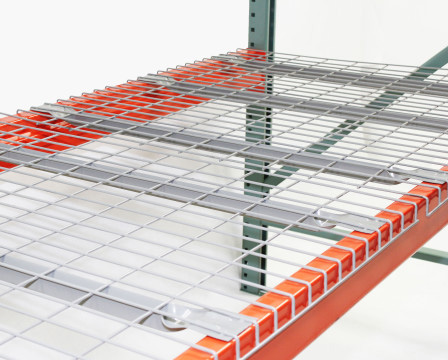 Wire decking is incorporated by a lot of facilities to support heavy loads. Even though steel wires aren’t as thick as they used to be, they still must meet industry standards in terms of supporting a load that is uniformly distributed as well as the deck’s surface. The decking must have a deflection rate that is not greater than 1.5 times the rated capacity and at least twice the capacity that can be sustained for five minutes in order to support a pallet’s static load.
Wire decking is useful for safety protection guidelines, but it should not be used as a support mechanism. Wire decking prevents damage and injuries to workers by keeping loose items from falling and allows for the storage of split and open cases. It also offers added safety in fire emergencies. Warehouses once used plywood instead of wire decking, which can fuel fires, regardless of how well it prevents loose products from falling. Wire decking does not do this. It allows water to pass through racks from sprinklers to aid in putting out fires.
- Wire decking comes in three different types: waterfall, flush flat, and inverted flange.
- Waterfall wire decking has support channels that rest on the rack beam’s steps. The “waterfall” wraps around the top of the rack beams.
- Flush flat wire decking is flush with the top of the beams.
- Inverted flange decking prevents debris from accumulating in the support channel.
Pallet Supports
Pallets have a uniform strength and design, but their load remains static, unlike their design. Type of loads, use, and abuse all affect pallet performance because additional support is often needed to prevent unforeseen accidents from occurring. Pallet supports work with pallets that are evenly sized.

Wire decking and other types of pallet supports do not offer additional strength to rack systems, which allow for increased load weight. What pallet supports do is maintain their structural integrity by supporting the bottoms to prevent them from falling between the beams to minimize the amount of deflection.
Pallet supports mostly come in metal in four designs:
- Drop Over: placed inside of the step with a flange that holds the support in place and waterfalls over the beam
- Snap-In: used for slotted beams
- Drop-In: placed inside of the rack beam’s step
- Bolt-In: the crossbeam of the supports is bolted to the structural beams
Pallet supports and wire decking are affordable as we discussed earlier. The difference is that pallet supports are less expensive than wire decking. However, the costs between the two only represent a fraction of a facility’s operation costs which is why many operators will use them together.
So, do you think pallet supports do a better job than wire decking? Should you consider using both? It really depends on how your pallet racks are set up as well as your application. Our experienced professionals can help you find the right product for your facility.


