
Order fulfillment speed and storage density often pull in opposite directions – the more product you pack into a footprint, the harder it can be to pick quickly. Gravity flow racking solves for both, but the right choice depends on what you’re actually storing. Let’s compare Carton Flow Pallet Rack vs Pallet Flow Pallet Rack
What is Carton Flow Pallet Rack?
Carton flow rack and pallet flow rack both use inclined tracks and gravity to move inventory from loading to picking, and both follow FIFO rotation. The difference comes down to scale: carton flow handles individual cases and totes for piece-picking operations, while pallet flow handles full pallet loads for high-volume distribution. Here’s how each one works, and how to know which fits your warehouse.
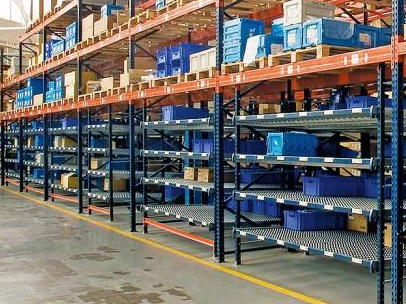
Carton Flow Key Benefits
- Increased Order Picking Efficiency
Allows for easy access and visibility to individual cartons, cases, or totes, reducing the time required for order picking. The inclined roller tracks facilitate smooth flow and retrieval of items, minimizing handling efforts and improving productivity. - FIFO Inventory Management
Follows a first-in, first-out (FIFO) inventory management system. This ensures that older products are picked first, reducing the risk of stock expiration or obsolescence. - Space Optimization
Maximizes the use of vertical and horizontal space within the warehouse. It provides high-density storage, allowing for more cartons or cases to be stored in a smaller footprint, optimizing space utilization. - Enhanced Organization
Products are neatly organized in lanes or tracks, making it easier to locate and identify specific items. This promotes a more organized and efficient inventory management system. - Minimized Stock Damage
The roller tracks in carton flow rack allow for the smooth movement of products without excessive manual handling. This reduces the risk of product damage or mishandling during storage or retrieval. - Improved Ergonomics and Safety
Carton flow rack minimizes the need for excessive bending or reaching, as items are presented at an ergonomic height for easy access. This helps to reduce strain on workers and improve safety in the warehouse. - Versatility and Customization
They can be designed with adjustable lane dividers or flow lanes to accommodate various carton or case dimensions.
Learn more about Carton Flow Racks & Product Slotting
What is Pallet Flow Rack?

Pallet flow rack is designed to handle larger loads such as pallets. It incorporates inclined gravity flow lanes, typically utilizing roller tracks or wheels, to enable pallets to flow smoothly from the loading end to the picking end. Pallet flow rack is ideal for high-density storage and dynamic inventory rotation. It supports a FIFO inventory management system, ensuring efficient product rotation and reducing the risk of product obsolescence. Pallet flow rack is commonly used in industries with high-volume storage and order fulfillment operations.
Carton flow rack offers several benefits for efficient warehouse storage and order picking operations.
Pallet flow racks are ideal for businesses with a need for high-capacity, efficient storage of palletized goods, and a focus on FIFO inventory management, whereas carton flow racks are better suited for smaller, individual items and piece-picking operations. The choice between the two depends on the specific requirements of your warehouse or distribution center.
Key Benefits of Pallet Flow Rack
- Fewer Aisles, More Storage Lanes
Because pallets load and pick from opposite ends of the same lane, pallet flow eliminates the pick aisles required by standard selective rack. This frees up floor space for additional storage lanes rather than just compacting what’s already there. - Reduced Forklift Congestion
Loading and picking happen on separate sides of the system, so forklifts never cross paths in the same aisle. In high-volume operations with multiple forklifts running simultaneously, this cuts down on traffic bottlenecks and wait times at the rack face. - Fewer, Larger Picks
Pallet flow is built around retrieving full pallet loads rather than individual units, so a single pick moves significantly more product per trip. This makes it a better fit for bulk replenishment and full-pallet order fulfillment than for piece-picking. - Consistent Cold Storage Performance
Because product flows automatically without manual repositioning, pallet flow systems hold up well in refrigerated or frozen environments where minimizing time in and out of temperature-controlled space matters. Fewer manual touches also means less time doors are open or workers are exposed to cold conditions. - Higher Throughput for High-Volume Distribution
Pallet flow is designed for continuous, large-scale movement of inventory – well suited to distribution centers processing high pallet volumes daily, where selective rack’s one-pallet-per-position access would create a bottleneck. - Lower Labor Cost per Pallet Moved
Because product self-feeds to the pick face, fewer labor hours are needed to move the same volume of pallets compared to systems that require searching, repositioning, or deep-reach retrieval. - Structural Depth for Multiple SKUs
Lanes can be built to varying depths, allowing a facility to dedicate specific lanes to specific SKUs based on velocity – fast movers up front, slower movers further back – without redesigning the whole system.
Comparison Table
| Carton Flow Rack | Pallet Flow Rack | |
|---|---|---|
| Unit handled | Cartons, cases, and totes | Pallets |
| Best for | Piece-picking and fast-moving SKUs | High-volume palletized storage |
| Inventory method | FIFO | FIFO |
| Typical use case | Order fulfillment and e-commerce picking | Distribution centers and high-volume rotation |


