
As warehouse space tightens and inventory levels grow, the need for a smarter Pallet Rack System becomes essential. Many facilities reach a point where selective racking no longer delivers the density required to stay competitive. Enter high-density storage systems.
Push Back Rack, Drive-In Rack, and Pallet Flow Rack systems are designed to increase pallet positions without expanding the building footprint. Each system works differently. Each supports different inventory strategies, and each impacts safety, labor efficiency, and throughput in unique ways.
If you manage warehouse operations or oversee capital improvements, choosing the right Pallet Rack System is critical. This guide breaks down how these high-density options work, when they make sense, and how to decide which one aligns with your product mix and operational goals.
Why High-Density Pallet Rack System Matters
Warehouse real estate costs continue to rise across major logistics markets. Expanding outward is expensive. Expanding upward and inward through smarter racking is often more practical.
A high-density Pallet Rack System increases storage capacity by reducing aisle space. Traditional selective racking may dedicate up to 40 percent of floor space to aisles. High-density systems reclaim much of that area.
This shift directly improves:
- Storage capacity per square foot
- Inventory consolidation
- Space optimization without construction
For distribution centers handling large SKU volumes, dense storage also improves inventory control by grouping similar products together.
However, density introduces complexity. The wrong system can slow throughput, complicate picking, or create safety concerns.
A common mistake is choosing density without evaluating inventory turnover. A Pallet Rack System must match both space constraints and product velocity.
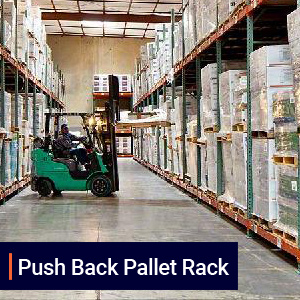 Push Back Pallet Rack Systems
Push Back systems store pallets on nested carts that roll on inclined rails. When a new pallet is loaded, it pushes the previous pallet backward.
How It Works
This system operates on a Last In First Out model. Each lane holds multiple pallets deep. Retrieval occurs from the front face of the rack.
When Push Back Works Best
Push Back Rack is ideal for:
- Medium SKU variety
- Moderate turnover
- Multiple pallets per SKU
Because forklifts do not enter the rack structure, the risk of rack damage decreases compared to Drive-In systems.
Safety Considerations
Push Back lanes rely on gravity and cart alignment. Regular inspection ensures carts roll smoothly and stop correctly. A unique operational advantage is reduced aisle congestion. Each lane allows multiple pallets while maintaining front-face accessibility.
For many warehouses seeking balance between density and selectivity, Push Back offers an efficient Pallet Rack System compromise.
View Our Push Back Pallet RackDrive-In Pallet Rack System
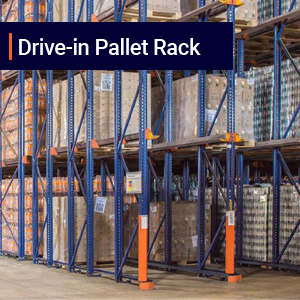
Drive-In racking allows forklifts to enter the rack structure to store pallets several positions deep.
How It Works
This system follows a Last In First Out inventory model. Pallets sit on rails rather than beams. Drive-In creates deep lane pallet rack configurations, maximizing cubic storage.
Strengths
Drive-In systems:
- Deliver high storage density
- Work well for bulk inventory
- Minimize aisle requirements
For facilities storing large quantities of the same product, this Pallet Rack System maximizes space.
Risks
Because forklifts enter the rack, the risk of impact damage increases. Proper operator training and rack protection are essential. Drive-In works best in low-SKU, high-volume environments. In high-turnover operations, it may create traffic slowdowns.
View Our Drive-in Pallet RackPallet Flow Rack System
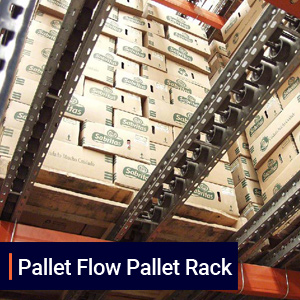
Pallet Flow systems use gravity rollers to move pallets from the loading side to the picking side.
How It Works
This system operates on a First In First Out model. Pallets load at one end and flow forward automatically.
Operational Benefits
Pallet Flow supports:
- FIFO inventory control
- Perishable goods rotation
- High throughput environments
Gravity flow racking reduces manual pallet handling. It improves pick accuracy and labor efficiency.
Safety and Engineering
Because pallets move under gravity, lane slope and brake systems must be calibrated correctly. Pallet Flow is often selected for food, beverage, and time-sensitive inventory. It provides one of the most efficient high-density Pallet Rack System designs when rotation matters.
View Our Pallet Flow RackComparing High-Density Systems
| Feature | Push Back | Drive-In | Pallet Flow |
|---|---|---|---|
| Inventory Model | LIFO | LIFO | FIFO |
| Forklift Entry | No | Yes | No |
| SKU Flexibility | Moderate | Low | Moderate |
| Storage Density | High | Very High | High |
| Damage Risk | Moderate | Higher | Moderate |
| Ideal For | Mixed SKUs | Bulk storage | Perishables |
Choosing the Right Pallet Rack System
When selecting a high-density Pallet Rack System, evaluate:
- Inventory turnover rate
- SKU diversity
- Product shelf life
- Operator skill level
- Available ceiling height
Push Back Rack suits mixed operations needing flexibility.
Drive-In Rack suits large volumes of uniform product.
Pallet Flow Rack suits FIFO environments where rotation is mandatory.
Cost and Long-Term ROI
High-density systems require greater upfront investment compared to selective racking. However, they increase pallet positions without expanding the facility.
Cost considerations include:
- Rack structure materials
- Installation complexity
- Floor load capacity
- Forklift training
Long-term ROI improves when storage density aligns with product velocity. A warehouse that reduces off-site storage through optimized racking often recovers investment quickly. The best Pallet Rack System is the one that supports both present inventory and projected growth.
Selecting a high-density Pallet Rack System is a strategic warehouse decision. Push Back, Drive-In, and Pallet Flow systems each offer distinct advantages. The safest and most efficient choice depends on inventory turnover, SKU count, and operational flow.
Push Back balances accessibility and density. Drive-In delivers maximum cubic utilization for uniform inventory. Pallet Flow ensures FIFO compliance and streamlined picking.
Before upgrading your racking, evaluate how your product actually moves, map turnover rates, review forklift traffic patterns, and consider future growth plans.
A well-designed Pallet Rack System improves storage capacity, reduces costs, and supports long-term operational efficiency.
If you are considering a high-density solution, consult with a warehouse design specialist to ensure your layout, floor capacity, and fire protection systems align with your storage goals.
Frequently Asked Questions
What is a high-density Pallet Rack System?
It is a storage configuration that reduces aisle space to increase pallet capacity per square foot.
Which Pallet Rack System is best for FIFO?
Pallet Flow systems are best for FIFO inventory management.
Is Drive-In racking safe?
Yes, when properly installed and operated, but forklift impact risk is higher.
How many pallets deep can Push Back systems go?
Typically two to six pallets deep depending on design.
Does high-density racking require stronger floors?
Yes. Increased load concentration requires floor load evaluation.


