
Proper inventory management is extremely important in today’s ever-changing market and one of many challenges warehouse professionals face daily. The right warehouse racking system can help you efficiently streamline your warehouse operations.
Here we define what warehouse racking systems are, several factors you should consider prior to purchasing a warehouse racking system, and the different types of systems that are available.
Warehouse Racking Systems
Warehouse racking systems are intended for stacking materials on horizontal shelves with multiple levels. They can help you streamline your operations by keeping your products organized so that you can better utilize and manage your warehouse space.
Factors to Consider
Because every warehouse has different requirements, the racking system you select should be able to increase your overall space without obstructing your operations, primarily the picking process.
To determine the appropriate system for your facility, you should consider the following factors:
- Inventory Management
Your warehouse’s order of retrieval for all inventory - Adaptability
A racking system’s ability to accommodate a broader range of products - Forklift Accessibility
The ability to accommodate forklifts to retrieve bulky products, taking into account the necessary aisle width needed for forklifts to maneuver - Storage Capacity
The amount of available space that can be utilized in the racking system, which will depend on the weight, size, and quantity of your goods - Floor Capacity
The racking system’s ability to maximize your available floor space - Budget
The projected cost for each pallet, which should always be considered to ensure that the racking system satisfies your needs
Warehouse Racking System Types
Selective Racking System
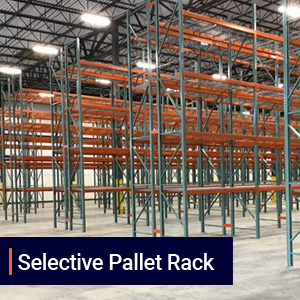 One of the most popular systems is the selective racking system as it has a large selection of different sizes and accessories to choose from and a relatively inexpensive design. It’s great for standard storage and offers immediate access to your inventory.
- Inventory Type: First In, First Out (FIFO) or Last In, First Out (LIFO)
- Adaptability: Handles multiple types of goods
- Forklift Accessibility: Any type of forklift will work with selective racking, but the style of forklift will determine how wide your aisles need to be to accomodate picking and putting.
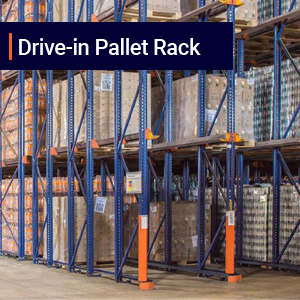
Drive-In Racking Systems
Drive-in racking systems eliminate aisles in your facility and can store large amounts of similar items in a small space (maximum density storage).
- Inventory Management: Last In, First Out (LIFO)
- Adaptability: Different products cannot be mixed in every row – only similar products can be stored together
- Forklift Accessibility: Forklifts will need to have a narrower body to be able to drive in the system
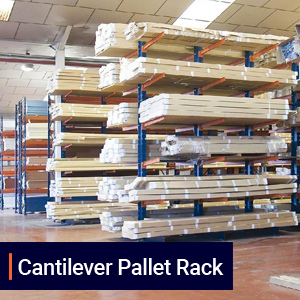 Cantilever Pallet Rack Systems
Cantilever pallet rack systems are best for long and odd sized loads. Many businesses use this type of pallet rack to store carpet, pipes, lumber, etc. The loads are stored horizontally on industrial-grade “arms” and can be retrieved easily using forklifts. This type of racking can be single or double-sided allowing you to make the most use of the space available.
- Inventory Management: First In, Last Out (FILO)
- Adaptability: Best for storing long or odd-shaped inventory
- Forklift Accessibility: Counterbalanced forklifts or combines are good options.
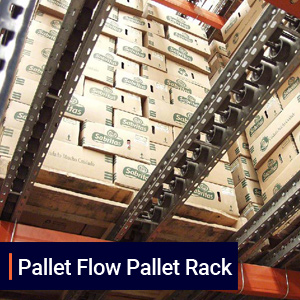 Pallet Flow Racking Systems
A pallet flow rack uses a combination of dynamic components, including conveyors and gravity rollers, along with elevated rails. The racks use gravity and can help you double or triple your warehouse storage space. They are best suited for products that are expiration-date sensitive.
- Inventory Management: First In, First Out (FIFO)
- Adaptability: Optimal for storing similar high-volume and SKU items
- Forklift Accessibility: Any type of standard forklift is supported
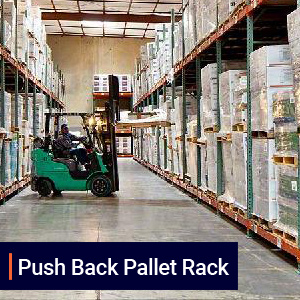 Push Back Racking Systems
Push back racking systems maintain better selectivity and offer additional pallet storage. Each SKU is located in a different lane so that items are easier to find, pick, or put back. These racks eliminate the need for multiple aisles by using front loading and unloading.
- Inventory Management: Last In, First Out (LIFO)
- Adaptability: Optimal for storing similar SKU items
- Forklift Accessibility: Any type of standard forklifts are supported
Due to the variety of racking systems currently available on the market today, it can be a daunting task to find the right warehouse racking system to fit your needs. The factors mentioned above should help you avoid becoming overwhelmed with this undertaking.
We can help you maximize your space and streamline your warehouse operations more efficiently with the right warehouse racking system.


